Welcome to the January 2026 newsletter!
Please contact info@ammnet.org if you would like to contribute any items to next month’s newsletter.
AMMnet wishes you a very happy new year 2026!
Register for the AMMnet Monthly Seminar
February 3, 15 hr UTC
From Parallel to Integrated: Harmonizing SMC and Routine Supply Chains in Northern Nigeria
Presenter: Michael Audu
This study analyzes the "verticality trap" in Northern Nigeria, where fragmented logistics systems contribute to persistent malaria treatment gaps. Using a retrospective analysis of DHIS2 data (2022–2024) across Kebbi, Sokoto, and Zamfara, the research evaluates the structural misalignment between routine case management (ACTs) and Seasonal Malaria Chemoprevention (SMC) campaigns.
The Key Findings are 1) Treatment Deficits 2) System Saturation 3) Data Incongruity.
The Presentation proposes an Integrated Logistics Framework designed to harmonize quantification and distribution schedules. By transitioning from parallel to integrated systems, Nigeria can reduce stock outs, improve data quality, and safeguard equitable access to life-saving commodities.
About the presenter:
Michael Audu is a Malaria Expert, Public Health Security Advocate, and Supply Chain Integration Strategist specializing in the West African health landscape. Currently a DrPH candidate at the University of Port Harcourt, Nigeria, Michael holds an MPH and a Master’s in International Affairs and Diplomacy (MIAD). His work operates at the critical intersection of infectious disease control, Global Health Security, and Artificial Intelligence.
As the Principal Investigator of "Project Foresight" at the University of Port Harcourt, Michael leads the development of AI-powered malaria prediction models and climate-adaptive logistics strategies designed to safeguard "last-mile" access in flood-prone and insecure regions.
A vocal proponent of African health sovereignty, Michael focuses on breaking "verticality traps" by integrating parallel supply chains into resilient, harmonized systems. His research and strategic insights have been featured at major continental forums, including CPHIA 2025, where his work was recognized for its strategic alignment with the Africa CDC’s New Public Health Order.
Real-time interpretation to French will be available and translated CAPTIONS to Portuguese will be available on Zoom
Register Here for the Seminar Series
Register for the next AMMnet Career Development Seminar | February 12, 16 hr UTC
Grant Writing and Management Seminar
Presenter: Elizabeth Christian from Northwestern University
The presentation will review core competencies for building grant budgets, direct costs versus indirect costs, and review how funders may perceive grant budgets.
About the presenter:
Elizabeth Christian, MPPA serves as the Research Program Manager at the Northwestern Havey Institute for Global Health. She has worked on global health research projects for over 10 years with experience in grant applications, implementing projects, monitoring programmatic activities, and reporting to sponsors, including the National Institutes of Health. She was a co-investigator on a NIH G11 grant to develop research administration capacity at Makerere University. As part of this project, she developed training on budget development and budget justification for grant applications, and spearheaded the overall training evaluation.
Christian holds a master's degree in public policy and administration focusing in global policy, certificate of applied program management, and certificate of data analysis and visualization from Northwestern University.
The webinar is in English ONLY but translated CAPTIONS to French or Portuguese will be available on Zoom.
Register Here for the Career Development Seminar
AMMnet Small Event Award — Call for Proposals!
AMMnet is pleased to announce an exciting funding opportunity for members: the AMMnet Small Event Award — supporting small, local, in-person events of up to $3,000.
This award is designed to help AMMnet members organize meetings, conferences, workshops, or other gatherings that strengthen connections among malaria modelers, data analysts, and partners.
Deadline: Submit your application to info@ammnet.org by February 1, 23:59 GMT.
Funding: Up to $3,000, to be spent within 12 months of the award date.
🛑 Mandatory Requirement
You must use the official Small Event Award Template available on our website (in English, French, and Portuguese).
The template is your proposal. Applications not using the template will not be considered.
Visit our website for full details and access to the template and guidance documents.
📄 Required Application Materials
Include the following items with your submission:
- Completed Small Event Award Template
- Biosketch (CV or résumé) for key personnel
- Letter of support from the main organizer’s institution, signed by an institutional authority, confirming:
- The organizer’s position in the institution
- The institution’s support for the application and proposed activities
ℹ️ Eligibility
Applicants do not need to represent a local AMMnet chapter.
Any individual AMMnet member is eligible to apply for the Small Event Award.
Proposal needs to be led by one or more AMMnet members based in a malaria-endemic country.
For details and templates, visit our website.
More information, required template and guidance here
Register for the Next Francophone Seminar!
Impact of the carriage of the RR, RS and kdrgenotypes on the prevalence of microsporidia infection in An. gambiae s.s. and An. coluzzii in southern Benin.
Date: Thursday, January 29
Time: 13:00 GMT
Presenter: Dr. Totongnon Gerard
If you would like to host a seminar or hackathon in French, contact us at info@ammnet.org.
The webinar is in French ONLY but translated CAPTIONS to English or Portuguese will be available on Zoom.
Register Here for the Francophone Seminar
Meet-the-Modelers: Call for Volunteers!
Thanks to all past presenters for sharing your backgrounds and professional experience!
Want to introduce yourself with a quick 2-minute lightning talk at an upcoming AMMnet monthly seminar?
A great opportunity to:
- Showcase your work
- Gain visibility
- Connect with peers
Interested?
Click on the link below to sign up!
Fill out the Meet-the-Modeler Interest Form Here
Have news, events or resources to share?
Use AMMnet’s Social Media Request Form!
Click on the link below to submit your request, and we’ll consider your post for Facebook, X, Bluesky, and LinkedIn.
Else you can send your request by email to info@ammnet.org.
Find the Social Media Posting Request Form Here
Job Opportunities:
Impact Evaluation Training and Matchmaking Workshop for African researchers and policymakers
The African Centre for Development Impact (ACDI) invites applications for its Impact Evaluation Training and Matchmaking Workshop for African researchers and policymakers. The programme will take place in Accra, Ghana, from 23 to 26 March 2026.
The workshop will be delivered in English and French and adopts a practical, hands-on approach. It is structured to equip participants with the tools needed to design and implement impact evaluation studies focused on priority government interventions.
Application deadline is 23 January 2026.
Special Issue Call for Papers in Epidemics - Training the Future: Replicable Strategies for Teaching Infectious Disease Modeling Forecasting and Analytics
We would like to call your attention to a special issue in Epidemics, “Training the Future: Replicable Strategies for Teaching Infectious Disease Modeling, Forecasting and Analytics”, and invite your submissions.
Through this special issue, we aim to promote access to high-quality training by summarizing replicable programs (e.g., workshops, fellowships, and webinars) within citable scholarly publications. Articles will describe the design, implementation, and evaluation of programs, with supplementary materials that can be reused or adapted for future training activities. We invite submissions on initiatives spanning the career spectrum and global contexts. A limited number of review articles are also welcome.
If you’re considering a submission or have questions about fit, please feel free to reach out to any of the guest editors.
Submission deadline is 15 June 2026.
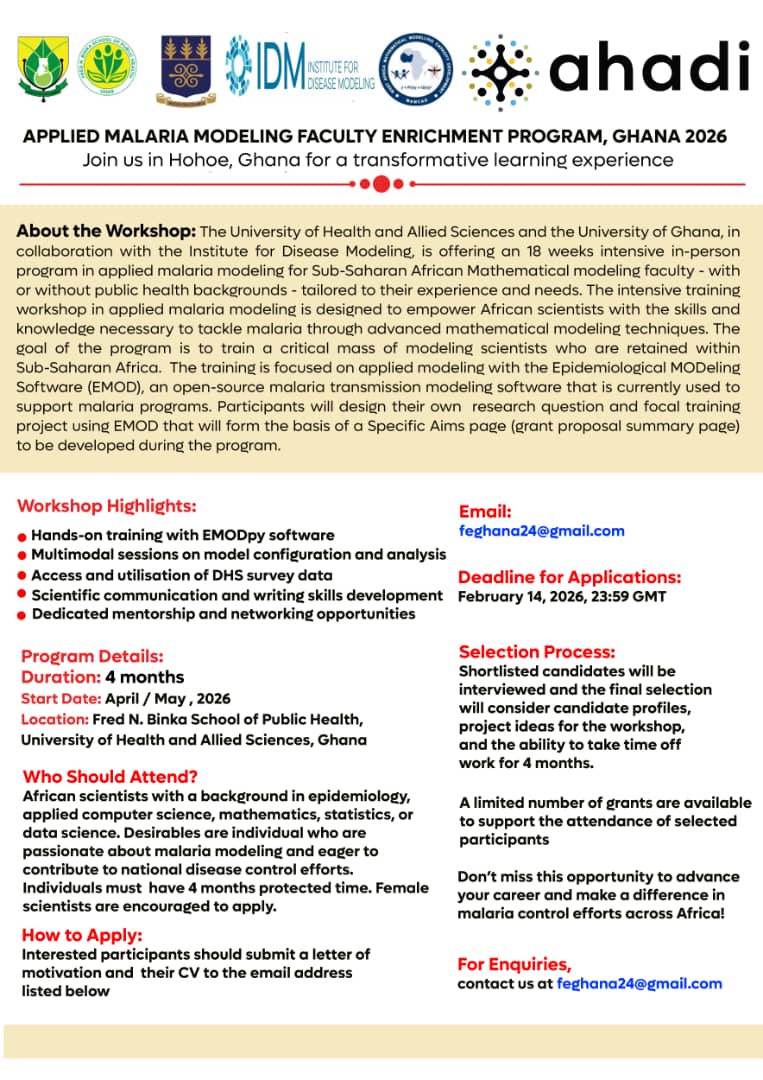
Applied Malaria Modeling Faculty Enrichment Program – Ghana 2026
The University of Health and Allied Sciences (UHAS), in collaboration with the University of Ghana and the Institute for Disease Modeling (IDM), is pleased to announce the Applied Malaria Modeling Faculty Enrichment Program (FE-Ghana 2026). This intensive in-person faculty enrichment program, to be held in Hohoe, Ghana, is designed to strengthen applied malaria modeling capacity among Sub-Saharan African scientists and faculty.
Application deadline is 14 February 2026.
Interested participants should submit a letter of motivation and their CV to feghana24@gmail.com
Courses and Learning Opportunities
Sunday Weekly Course: Data Analysis and Visualization Using R
Join us every Sunday for a virtual course series on Data Analysis and Visualization Using R, led by Shakira Babirye (Biostatistician/Data Scientist, Infectious Diseases Research Collaboration).
📅 When: Sundays, 7:00–8:00 AM (GMT+3, East African Time)
📍 Where: AMMnet Zoom (link provided upon registration)
👩🏽🏫 Instructor: Shakira Babirye
✉️ To Join: Email Shakira at bbrshakira@gmail.com to receive the Zoom link.
Recordings of previous sessions are available on the AMMnet YouTube channel (link below)
AMMnet YouTube Channel-Course Recordings
Online Course on Effective Communication of Research Findings for Evidence Informed Decision-Making in Public Health Available at MESA
The Special Programme for Research and Training in Tropical Diseases (TDR) is inviting registrations for the “Massive open online course (MOOC) on Effective Communication of Research Findings for Evidence-informed Decision-making in Public Health.
A free, online training course is now available to help researchers bridge the gap between evidence generation and real-world impact. Developed by TDR, the new massive open online course provides researchers with practical skills to increase the uptake of their findings for policy and practice changes.
A certificate of completion is provided after completing the course.
Subgroups, Working Groups, and Regional Activities
AMMnet has 5 established local chapters!
And two new local chapters under review – Burkina Faso and Benin.
If you would like to be connected with local chapters in Cameroon, Tanzania, Liberia, Uganda or Zambia, you may send email using the respective addresses below.
- AMMnet Uganda Chapter, ammnetuganda@gmail.com
- Applied Malaria Modeling Network Zambia, ammnetzambia@gmail.com
- AMMnet Liberia Chapter, ammnet.liberia@gmail.com
- AMMnet Cameroon Chapter, ammnetcameroon@gmail.com
- AMMnet Tanzania Chapter, ammnettz@gmail.com
Establish an AMMnet Local Chapter to Strengthen Malaria Modeling and Analytics in Your Region
AMMnet’s Local Chapters bring together modelers, analysts, scientists, public health professionals, partner institutions and civil society, to work together locally to adopt common approaches to improve the use of modeling and analytics for controlling and eliminating malaria whilst reflecting the mission of global AMMnet.
Establishing a local AMMnet chapter is a three-step process:
- Pre-registration with global AMMnet
- A completed Local Chapter Establishment Application Form
- AMMnet Board approval with guidance from the Local Chapter Development Task Force
If you are an AMMnet member and you are interested in establishing a local chapter, please refer the information and guidelines found at the link below.
If you have any questions, considerations or suggestions for establishing local AMMnet chapters, please send us an email at info@ammnet.org.
22 AMMnet local chapters are in the process of establishment. Refer to the list of those local chapters below and their stage of establishment.
Local Chapters with Establishment in Process
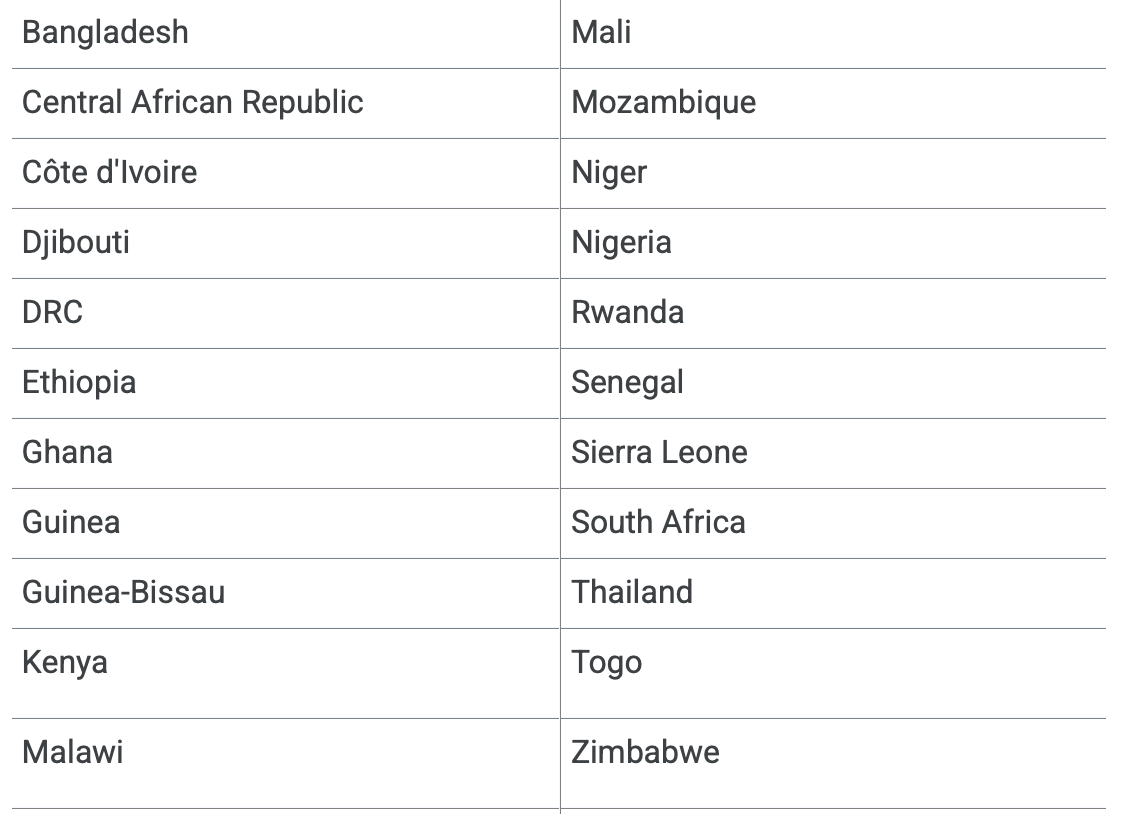
Send an inquiry to info@ammnet.org if you feel your local chapter has not been included by mistake or if you wish to be connected with a local chapter contact. info@ammnet.org if you feel your local chapter has not been included by mistake or if you wish to be connected with a local chapter contact.
Local Chapter Information & Guidance
Member Reading Corner
If you'd like to share a paper or any other publication with the AMMnet community, send an email to info@ammnet.org and we will consider including it in the newsletter.
Seminar Recap and Recordings
AMMnet Seminar Series
January 6, 2026, 15 hr UTC
Different bioassays, consistent predictions: Comparing semi-field methods for insecticide-treated net evaluation
Presenter: Emma Fairbanks, Research Fellow in Health Inequalities in the Mathematics Department at the University of Manchester.
This presentation focused on evaluating malaria vector control interventions—specifically insecticide-treated nets (ITNs)—by comparing traditional experimental hut trials with newer Ifakara ambient chamber tests. The presenter explained how mosquito feeding and mortality behaviors (before and after feeding) can be quantified using hierarchical Bayesian models tailored to the different types of data generated by these two testing approaches.
Results showed that while ambient chamber tests often produced more conservative estimates than experimental huts, both methods yielded broadly consistent patterns in reduced feeding and increased mortality, leading to similar predictions of reduced malaria transmission potential. Overall, the findings suggest that ambient chamber tests can provide reliable, cost-effective early evidence to guide the selection of vector control interventions for malaria control programs, supporting more efficient, evidence-based decision-making.
Hackathon series
January 14, 2026, 13 hr UTC
GitHub, R & Quarto for Reproducible Public Health Data Science
Presenter: Justin Millar, PhD, Research Scientist at PATH.
This was a hands-on, two-hour collaborative workshop focusing on building practical skills in reproducible analytics. Participants were able to learn how to set up and use Git and GitHub within RStudio, structure collaborative data projects, track changes with version control, and publish dynamic Quarto documents and websites using GitHub Pages.