Welcome to the August 2025 newsletter!
Please contact info@ammnet.org if you would like to contribute any items to next month’s newsletter.
Register for the AMMnet Monthly Seminar
September 2, 2025, 15 hr UTC
Modelling to Inform Malaria Vaccine Policy: Supply and Equity as Key Factors
Presenter: Muktar A. Gadanya
This talk reviews how mathematical and decision-analytic models can directly inform malaria vaccine policy when policy makers need to account for vaccine supply constraints and equity objectives. Using Nigerian epidemiological context and international vaccine rollout experience as examples, the presentation links model outputs (impact, cost-effectiveness, and distributional outcomes) to real-world supply scenarios and equity frameworks, offering practical recommendations for policymakers on allocation strategies that balance population impact with equity.
About the speaker:
Professor Muktar A. Gadanya, MFR, is Professor of Community Medicine / Public Health Physician at Bayero University, Kano, and Honorary Consultant Public Health Physician at Aminu Kano Teaching Hospital, Kano. He serves as the Chairman of the Disease Working Group (Malaria) for Nigeria’s National Immunization Technical Advisory Group (NGI-TAG). He is a member of the Global Network for Anti-Corruption, Transparency and Accountability in the Health Sector (GNACTA) and won the 2023 British Council UK Alumni Award in Science and Sustainability in Nigeria. He is a recipient of the Presidential Honour of Member of the Order of the Federal Republic (MFR).
PSA: Real-time interpretation to French and Portuguese will be available.
Register Here for the Seminar Series
Register for the next Hackathon!
Cleaning and standardizing geographic names in R with sntutils::prep_geonames()
Date: Wednesday, September 24
Time: 11:00 GMT
Instructor: Mohamed Yusuf, PhD, Technical Advisor with AHADI and Data Scientist and Epidemiologist at the World Health Organization's African Regional Office, Nairobi, Kenya
About the session
This hands-on session will show how to use sntutils::prep_geonames() to clean and standardize administrative names in a structured, reproducible way. The workflow combines automated string-distance matching with an interactive review process to resolve mismatches, applies hierarchical keys to preserve geographic relationships, and saves corrections to a reusable cache for future use. Participants will learn how to run the function in both interactive and non-interactive modes, merge new corrections with existing ones, generate match statistics by administrative level, and integrate the process into broader R-based analytical pipelines. We will conclude with validation using targeted visualisation steps to check accuracy before finalising the workflow. The approach will be demonstrated with real-world datasets.
All experience levels are welcome! Register at the link below.
All registered participants should expect to receive an email with the session materials and downloads by the week of September 15, a week prior to the hackathon.
The session will be recorded and made publicly available to all AMMnet members via the hackathon blog.
We invite instructors of other languages to lead sessions. Reach out to info@ammnet.org if you are interested in leading a session in French or Portuguese.
Register Here for the Hackathon
Find the AMMnet Hackathon Blog Here
AMMnet Large Event Awards
We would like to sincerely thank each of our applicants for the time, creativity, and dedication that went into each of your Large Event Award submissions. We received 24 exceptional proposals from members in countries such as Tanzania, Benin, Togo, Guinea, Nigeria, Burkina Faso, Uganda, Mozambique, Kenya, Brazil, Cape Verde, Zambia, Sierra Leone, Ghana and Mali.
Thank you again for the energy, creativity, and spirit you all bring to AMMnet. We look forward to the many ways we continue connecting and working alongside all of you.
Congratulations to Our Latest Awardee – AMMnet’s First in West Africa!
Dr. Mac Abdul Falama, Medical Practitioner, Sierra Leone National Malaria Control Program and AMMnet Sierra Leone Local Chapter
Co-applicants: Musa Sillah-Kanu and Mohamed Sillah Kanu
The awarded event, Building Sustainable Analytics Capacity – R Training for Malaria Data Management and Analysis in Sierra Leone, will train 25 participants (including NMCP SM&E officers, regional officers, AMMnet local chapter members, and university lecturers and students) in the fundamental principles of malaria epidemiology and the concept of malaria surveillance. This foundation will be followed by a comprehensive data analytics training program using R, including practical modules on data management and a dedicated training module on malaria epidemiological stratification. To build participants’ competency and skills in data analytics, the program is structured as a combination of online and in-person training modules, supported by ongoing virtual mentorship.
Vote on re-electing AMMnet Board members for a second term.
AMMnet has 2 board members to consider.
AMMnet members choose whether they would like current Board members to continue their service for another term. This year, there are two members of the Board who are up for re-election. To review these Board members' contributions and cast your vote, please navigate to the voting form by selecting the button below.
The Board represents AMMnet members, sets the strategic vision of AMMnet, oversees the committee structure activities, and ensures leadership sustainability.
Susan F. Rumisha
Susan has been part of the Network since its infancy stage and has witnessed the enormous growth and expansion AMMnet has achieved in just a few years. She regards AMMnet as a powerful and essential platform that fulfils her long-standing passion: strengthening the ability of malaria-endemic countries in sub-Saharan Africa to use data for decision-making and action. She leads the Dar Node of the Malaria Atlas Project (MAP) at the Ifakara Health Institute, where her team provides technical and analytical support to countries across the elimination to high burden setting through R&D in advanced geospatial analytics that generate impactful insights for malaria initiatives. She is also an affiliate of The Kids Research Institute Australia (Australia ) and the National Institute for Medical Research (Tanzania).
Antonio Nkondjio Christophe
Antonio Nkondjio is a senior researcher in medical entomology of the Organisation for the Coordination of the fight against endemic diseases in Central Africa (OCEAC). His research interest are malaria vector control, malaria vector bionomic and vector borne diseases control. He has since 2009 contributed to capacity building in centrals Africa by working for different research and training organisations and supervising students at master, PhD and postdoc levels. He is a committed member of the AMMnet community, Antonio Nkondjio holds multiple key roles within the organization beyond his board duties.
ELECTION TO THE BOARD
Each Board member will be elected for 1 year and automatically renewed for 1 additional year if attendance criteria have been met. Board members can be re-elected with a maximum of 4 years of service allowed.
You may find more information about AMMnet governance in the Terms of Reference on our website here.
Please use the button below to navigate to the election form.
ONE VOTE PER MEMBER PLEASE.
DO NOT forward this message to other individuals. Only members are allowed to vote.
Vote Here by September 2!
Small Events Award
Congratulations to our latest Small Event Awardees!
Gashaija Absolomon
Centre for Impact, Innovation and Capacity Building for Health Information Systems and Nutrition, Rwanda, Modeling Antimalarial Drug Resistance in a Changing Climate: A Rwanda Workshop for Research and Policy-Driven Malaria Control
Nikiema Moustapha
Centre De Recherche En Sante De Nouna, Burkina Faso, Use of Spatial Modeling with QGIS in the Fight Against Malaria in Burkina Faso
Rabiu Musa
Tshwane University of Technology, South Africa, Advancing Malaria Intervention Strategies via Mathematical Modelling and Launching of the AMMnet Local Chapter in South Africa
Abubakar Abdullahi Madaki
Yobe State University, Nigeria, Mastering Data Visualization for Malaria Modeling: Empowering Healthcare Workers, Researchers & Students
Victoire Nsabatien
Vector Atlas, Kinshasa School of Public Health, Democratic Republic of Congo, Promoting Unpublished Vector Data Sharing to Support Malaria Vector Modelling and Targeted Interventions in DR Congo
Find More Information Here on Small Event Awards
In Memory of Didier Adjakidje
It is with deep sadness that we share the news of the passing of AMMnet member, Didier Adjakidje. Didier was an active member of several AMMnet committees and task forces, where he made significant contributions to the growth and strength of our network.
We will remember Didier not only for his professional dedication and the expertise he shared so generously, but also for his warmth and kindness. His presence enriched our community, and his absence will be deeply felt.
On behalf of AMMnet, we extend our heartfelt condolences to Didier’s colleagues, friends, and family. He will be greatly missed.
Job Opportunities
GiveWell Senior Malaria Researcher
GiveWell is seeking a Senior Malaria Researcher to help us direct hundreds of millions of dollars annually (we directed ~$250 million in 2024) to the most cost-effective malaria prevention programs that we can find. You will have an outsized influence on our funding decisions and help us save and improve lives on a global scale.
You will be joining a small grantmaking team to contribute to our ambitious research agenda on malaria. You’ll sift through the countless questions we could try to answer, and honing in on those that matter most. You’ll also communicate externally about your work and mentor and advise other researchers on the team.
You will shape a research agenda that brings rigor and creativity to the thorniest questions the GiveWell malaria team faces. Your work will combine empirical evidence review and critical synthesis, cost-effectiveness modeling, discussions with subject matter experts, understanding of the broader context, and your own judgment.
Find more information and apply here
Imperial College London Head of the Department of Infectious Disease and Chair
Imperial College London invites applications for the position of Head of the Department of Infectious Disease, a leadership role at the forefront of internationally recognised translational research. The Department’s research includes the fundamental biology of infectious diseases to the development and application of new approaches to treatment. There are major research programmes in human immunology and retrovirology, oncogenic human viruses, molecular microbiology, tuberculosis and vaccine development.
Further information: The role of Head of the Department will be, initially for five years, in line with the College’s term of office for senior roles. You will be employed as a Chair in a relevant subject on an open-ended basis within the Academic or Clinical Consultant Academic Job Family.
Informal inquiries about the role can be directed to the Dean of the Faculty of Medicine, Professor Deborah Ashby, Email: deborah.ashby@imperial.ac.uk.
For information on the recruitment process please contact: Maria Monteiro, Senior Appointments Manager, email: m.monteiro@imperial.ac.uk Telephone: +44 (0)207 594 5498.
Find more information and apply here
Courses and Learning Opportunities
Data Analysis and Visualization Using R
Sunday Weekly Course Series led by Shakira Babirye
Delivery Mode: Virtual via AMMnet Zoom
Schedule: Every Sunday, 7:00–8:00 AM GMT +03 (East African Time)
Instructor: Shakira Babirye, Biostatistician/Data Scientist, Infectious Diseases Research Collaboration (IDRC)
Contact: bbrshakira@gmail.com
If you'd like to join the virtual session on Sundays, contact Shakira at the email above and she'll send you a Zoom link.
You'll find recordings of Shakira's previous sessions on the AMMnet YouTube at the link below.
AMMnet YouTube Channel-Course Recordings
Applications are now open for the 2025 AREF Excell Malaria Researcher & Leadership Development Programme
AREF’s Excell malaria programme will enable 18 individual researchers from three participating institutions to build strong research careers, empower excellent teams, win research funds, work collaboratively, engage with research users – and so make an even bigger impact on improving health and saving lives.
Eligibility Requirements
- An employee of an African institution with a significant and specific role in Malaria research.
- A national of an African state
- 2-8 full years of active post-PhD research experience; or a clinician without a PhD with both an MD and research master’s and 4-8 years of active research experience.
- Not already having participated in previous Excell programme.
- AREF is keen to recruit talented researchers focusing on malaria research from a broad range of approaches, including laboratory, clinical, behavioural, social, public health, health systems, and environmental and mathematical sciences. Their research must be directed towards achieving better health outcomes in Africa and show alignment with their national Malaria research strategy, where applicable.
Application Deadline: 15th October, 2025
Click here for more information!
Workshops and Conferences
Register for the 2025 ASTMH Annual Meeting | November 9-13 in Toronto Canada
American Society of Tropical Medicine & Hygiene (ASTMH) will be holding its annual meeting from November 9 -13, 2025 at the Metro Toronto Convention Centre. Find more information below!
Subgroups, Working Groups, and Regional Activities
AMMnet currently has four established local chapters.
If you would like to be connected with local chapters in Cameroon, Liberia, Uganda or Zambia, you may send email using the respective addresses below.
- AMMnet Uganda Chapter, ammnetuganda@gmail.com
- Applied Malaria Modeling Network Zambia, ammnetzambia@gmail.com
- AMMnet Liberia Chapter, ammnet.liberia@gmail.com
- AMMnet Cameroon Chapter, ammnetcameroon@gmail.com
And two new local chapters under review – Burkina Faso and Tanzania!
Establish an AMMnet Local Chapter to Strengthen Malaria Modeling and Analytics in Your Region
AMMnet’s Local Chapters bring together modelers, analysts, scientists, public health professionals, partner institutions and civil society, to work together locally to adopt common approaches to improve the use of modeling and analytics for controlling and eliminating malaria whilst reflecting the mission of Global AMMnet.
Establishing a local AMMnet chapter is a three-step process:
- Pre-registration with global AMMnet
- A completed Local Chapter Establishment Application Form
- AMMnet Board approval with guidance from the Local Chapter Review Task Force
If you are an AMMnet member and you are interested in establishing a local chapter, please refer the information and guidelines found at the link below.
If you have any questions, considerations or suggestions for establishing local AMMnet chapters, please send us an email at info@ammnet.org.
21 AMMnet local chapters are in the process of establishment. Refer to the list of those local chapters below and their stage of establishment.
Local Chapters with Establishment in Process
BeninMaliBurkina FasoMozambiqueCentral African RepublicNigerDjiboutiNigeriaDRCRwandaEthiopiaSenegalGhanaSierra LeoneGuineaTanzaniaGuinea-BissauTogoKenyaZimbabweMalawi
Send an inquiry to info@ammnet if you feel your local chapter has not been included by mistake or if you wish to be connected with a local chapter contact. info@ammnet if you feel your local chapter has not been included by mistake or if you wish to be connected with a local chapter contact.
Local Chapter Information & Guidance
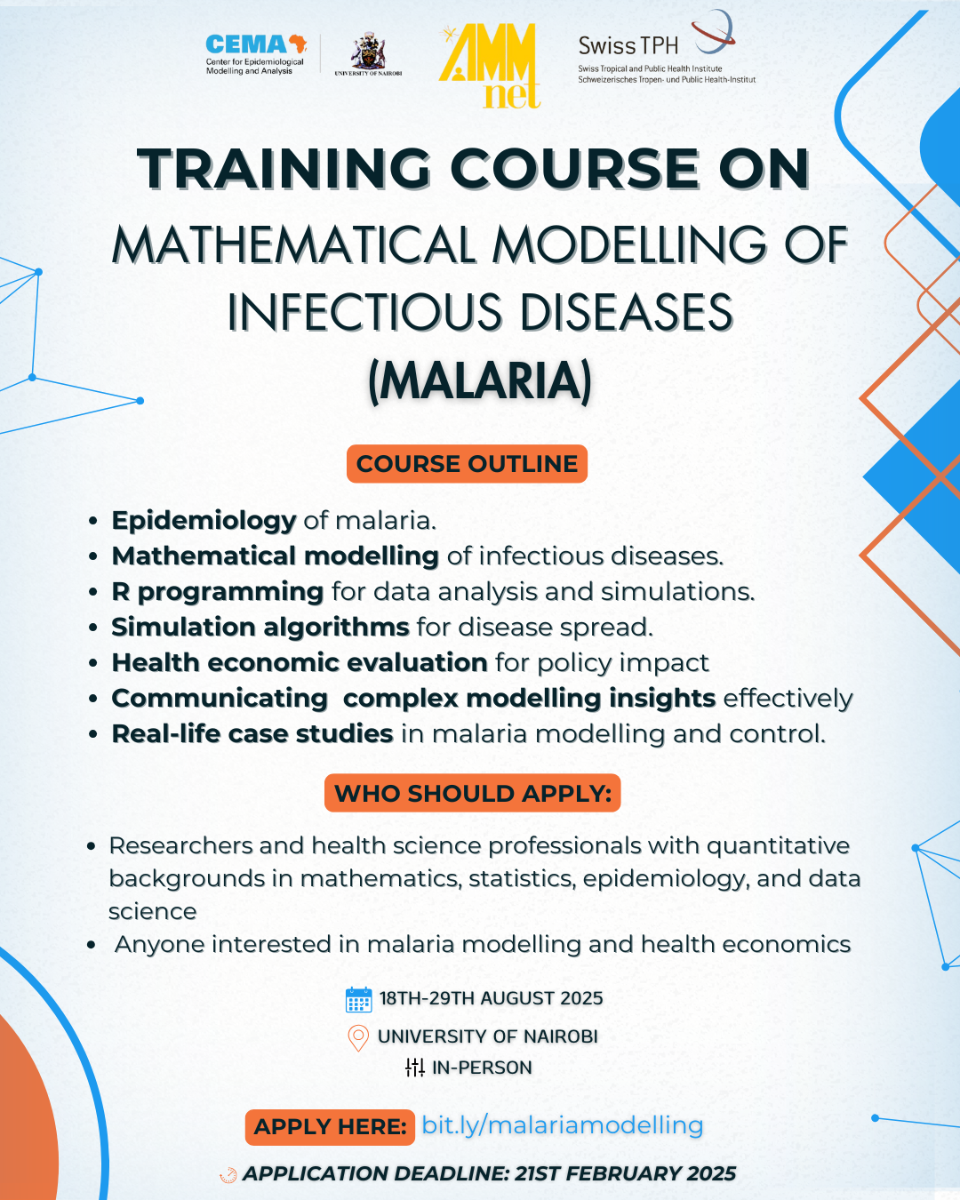
AMMnet's first funded Large Event launches in Nairobi
This week marks the launch of AMMnet’s first funded Large Event, co-hosted by AMMnet members, Mutono Nyamai (CEMA, University of Nairobi) and Cameline Orlendo (Swiss TPH).
The two-week intensive course, Mathematical Modelling of Infectious Diseases: Focus on Malaria, brings together participants to Nairobi, Kenya, for advanced training in epidemiological concepts, R programming, simulation algorithms, health economic evaluations, and policy communication.
Through guided projects and case studies, participants will apply these skills to real-world malaria control and elimination scenarios—strengthening both technical expertise and the translation of modeling into policy impact.
Member Reading Corner
If you'd like to share a paper or any other publication with the AMMnet community, send an email to info@ammnet.org and we will consider including it in the newsletter.
Seminar Recap and Recordings
AMMnet Seminar Series
August 5, 2025, 15 hr UTC
Principles for Slowing Artemisinin Resistance in Africa
Over the past 25 years, progress in malaria control reduced the per-capita death rate from malaria by a factor of three. Despite this, malaria continued to cause around 250 million cases and 600,000 deaths annually, mostly among African children under five. The most urgent near-term threat was the rise in treatment failures due to the spread of partially artemisinin-resistant parasites and reduced budgets for purchasing ACTs. High ACT treatment failure rates, about 15%, had been observed in Uganda, with similar issues likely to emerge in other regions where pfkelch13 mutants were spreading. Dr. Boni presented a malaria modeling framework incorporating recently spreading ART-R genotypes in East Africa and shared country-specific results for Rwanda, Uganda, and Tanzania, outlining policies to slow the spread of resistant parasites.
You may find recordings of this seminar along with others on our website or YouTube channel.
Recordings in French, English and Portuguese are available.
Find the Recording Here!
Board Meeting Summary
The Board met August 19, 2025
Present: Cherlynn, Hannah, Justin, Susan, Nadege, Antonio, Luc, Caitlin, Mor, Emilie (attending late)
Absent: Shakira
Secretariat present: Ida, Shannon, Hifzah, Jaline
Large Event Awardees
- Presentation from the task force
- Board discussion
- Individual votes
Advisory Board Agenda
- First hour AMMnet updates presentation, including:
- Panel presentation (part of it)
- What is happening with local chapters - AMMnet global TF + a local chapter spotlight
- AMMnet Francophone, Lusophone, and Asia-Pacific groups
- Gen session: seminars, membership growth, MESA Resource Hub
- Hackathons
- ToC
- Large and Small events
- Upcoming activities
- Ahadi updates + upcoming funding cycle
- Annual meeting overview
- Committee updates
- Multiple board members presenting
- Second hour discussion / advising
- From global to local chapters
- AMMnet sponsored trainings
- ToC: How do our operations and plans correspond to ToC; how should we adjust?
- Local Chapters: Advisors for local chapters and contributions to the network, local
- Are there strategies for connecting the local chapter to local partners? Is there a role for AMMnet global?
- What role should AMMnet play in SNT?
- Should it be linked with funding?
- creating opportunities for people to discuss the technical elements of SNT with others doing similar work?
- How do we consolidate what we have / committees / volunteer expectations / sustainability
- How do we reinvigorate involvement? (Succession planning). How to distribute contributions, expand/motivate/empowered participation beyond founding members?
- How do we strengthen and continue momentum, continue to maintain our audience?
- Discuss topics of succession and sustainability
- Consider Mentorship
- Strategies for broadening funding sources / diversification of funding sources
- Pathway to increased localization of AMMnet
- Increase quality of trainings offered to AMMnet members
- Do we see ourselves collaborating with others in this space?
- Do we see ourselves expand beyond malaria
AMMnet FR updates
- Restructured leadership with 3 subcommittees, which include 3 new people for each for a total of 9 in leadership
- Objective is to better structure, plan, and improve Francophone events throughout the year, while strengthening the active participation and visibility of Francophone members within the network
- Each subcommittee organized around 3 missions of AMMnet Francophone
- Organize French-language seminars and activities in a structured manner.
- Strengthen and structure interactions between French-speaking members of the network.
- Enhance AMMnet’s initiatives by increasing engagement of French-speaking members.
- The 3 subcommittees and their missions:
- Subcommittee 1: Strengthening Local Chapters
- Support AMMnet's local chapters through structuring, networking, and support for French-speaking groups
- Subcommittee 2: Organization of Virtual Events
- Plan, design, and implement virtual events tailored to the French-speaking community (seminars, hackathons, innovative training, relaying activities organized by Local Chapters).
- Subcommittee 3: Francophone representation and cross-functional support for AMMnet's global actions (Representation & Global Engagement?)
- Ensure the active representation of French-speaking members in AMMnet's strategic and technical actions at the global level, while facilitating their full participation in the network's initiatives.
- Subcommittee 1: Strengthening Local Chapters
- Feedback and thoughts from the Board?
- Makes sense; good structure. Congrats. More impactful with subcommittees.
- Leadership is asking each subcommittee to put together a workplan
- May use this to build an annual AMMnet global workplan, could be a model
- Be certain each activity align with ToC
- Slice of the funds e.g. small events to be allocated to the activities by language.
- Should have a Board representative on the AMMnet Francophone Board (could be non-voting)
- Can be more than one board member; 2 can tag team
- Antonio and Mor, Emilie as backup
- Can be more than one board member; 2 can tag team
- Shifted advisory board
- Lawrence K has left WHO Afro and Victor Alegana will step in