Welcome to the October 2026 newsletter!
Table of Contents:
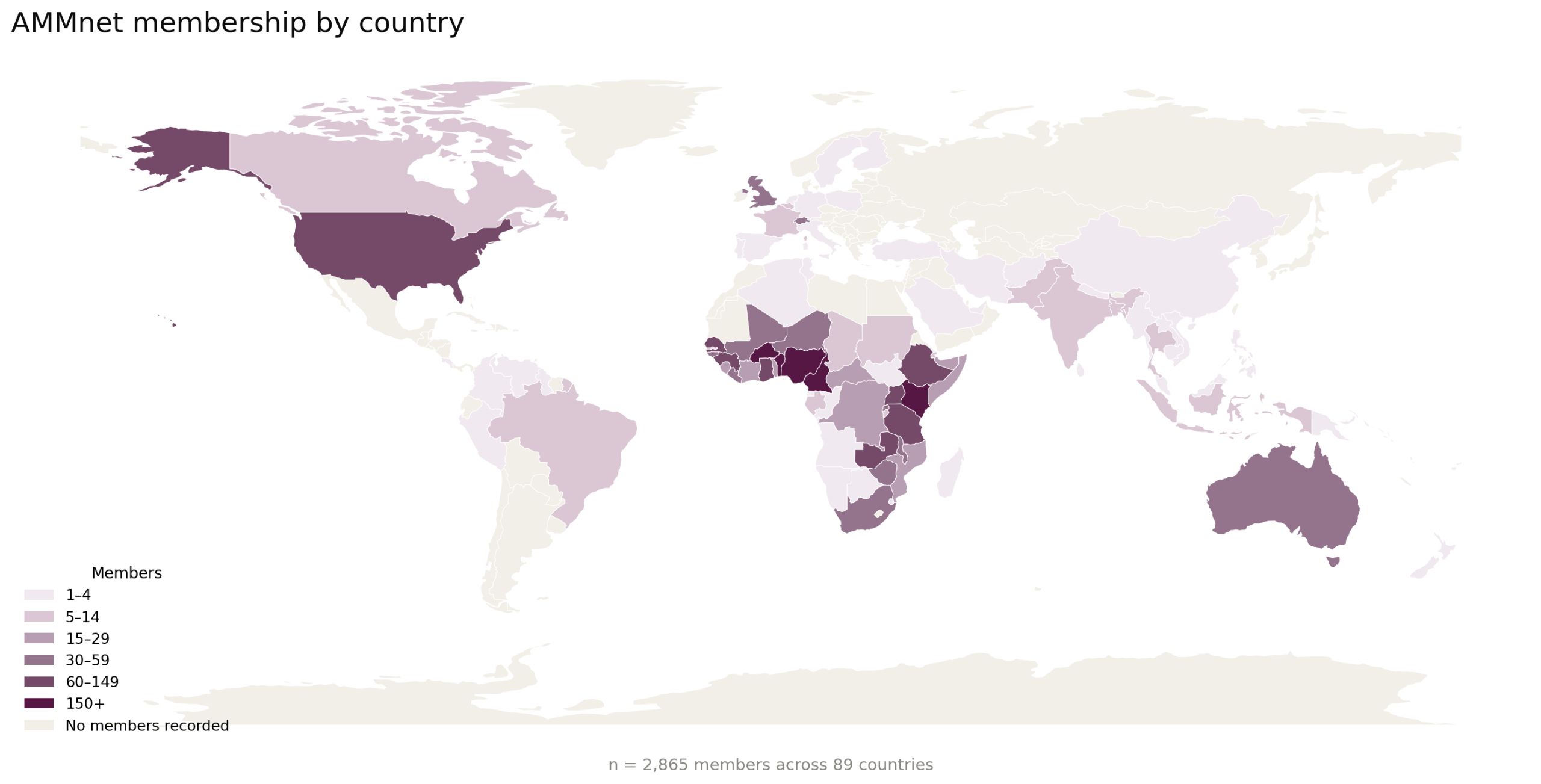
- Membership Map
- Feature Story
- AMMnet Annual Meeting Call for Abstracts
- Funding Opportunities
- Upcoming Events
- Training Resources
- Board Meeting Summary
- Stay Connected
Please contact info@ammnet.org if you would like to contribute any items to next month’s newsletter.
Membership Map
Feature Story "Lessons from Myanmar for Africa's Malaria Readiness"

By Michael Audu
In 2021, Thailand recorded approximately 2,000 malaria cases. By 2023, that figure had risen to 16,675, with more than 40% of cases imported, primarily from Myanmar.
One country’s health-system crisis can become another country’s public-health challenge. Myanmar’s health system has been severely weakened by conflict. The health workforce has been depleted, malaria cases have at least tripled, and restrictions on treatment provision have further undermined access to essential medicines. Drug-resistant malaria parasites are also spreading across borders.
For Africa, the lesson is not that we face Myanmar’s circumstances. It is that commodity security is a health-system function, not merely a procurement exercise.
Medicines can be procured and remain in the supply pipeline while patients go untreated because distribution networks, health facilities, financing or the workforce needed to deliver care have broken down.
As African countries prepare for next-generation antimalarials, the question is not simply whether we can introduce new treatments. It is whether our health systems can sustain equitable access when conditions deteriorate.
In my new policy commentary, “When Health Systems Collapse, Borders Cannot Contain Disease: Lessons from Myanmar for Africa’s Malaria Readiness,” I examine the implications for supply-chain resilience, drug resistance, donor transition, regional cooperation and health diplomacy.
The ultimate measure of readiness is not how well a health system performs when everything is working. It is how effectively it protects access to essential care when systems come under pressure. I welcome perspectives from colleagues working in malaria control, health systems, supply-chain management and health financing.
Join AMMnet in Kigali! 2027 Annual Meeting Call for Abstracts & Travel Awards
Join us in Kigali, Rwanda, for the 2027 AMMnet Annual Meeting, taking place alongside the 9th MIM Society Conference (MIM9), April 26–30, 2027 (specific dates and times for AMMnet activities will be announced soon).
We invite you to share your work and connect with our global community of malaria modelers, data analysts, researchers, and partners.
Call for Abstracts
We welcome abstracts for two 90-minute symposia:
Theme 1: Did the Model Change the Decision? Lessons from programme-led malaria analytics and modeling.
Theme 2: Beyond Prediction: Can AI and Machine Learning Answer the “What If” Questions Malaria Programmes Face?
We also welcome abstracts on other practical applications of data, analytics, and modeling for malaria.
- Deadline: November 23, 2026, at 11:59 AM GMT.
- Presentation formats: Oral presentations (10–15 minutes), posters, or both. Indicate your preference in the submission form.
- Notifications: During the week of January 4, 2027.
- In-person attendance is required. Virtual presentations will not be possible.
Travel Awards
A limited number of travel awards are available for selected presenters. You can apply directly through the abstract submission form.
We especially encourage submissions from our non-Anglophone members, women, and others underrepresented in malaria modeling and analytics.
Share your work, exchange ideas, and help shape the future of malaria analytics and modeling. We look forward to seeing you in Kigali!
More meeting details coming soon!
Funding Opportunities
Wellcome funding opportunities for malaria researchers
AMMnet members pursuing innovative research in malaria data analysis and mathematical modelling may wish to explore three Wellcome funding schemes:
- Early-Career Awards: Support researchers beginning independent research careers, providing a salary and up to £400,000 in research expenses, usually over five years.
- Career Development Awards: Support mid-career researchers developing independent research programmes and leadership. Funding usually lasts eight years, with annual research expenditure generally below £250,000, excluding the applicant’s salary.
- Discovery Awards: Support established researchers and teams pursuing ambitious research questions or developing new methods. Awards average £3.5 million and can last up to eight years.
Applications are accepted year-round. Research must meet Wellcome’s scientific remit and eligibility requirements. From 29 October 2026, lead applicants must be based at eligible administering organisations in the UK or eligible low- and middle-income countries in Africa, South Asia or South-East Asia.
Early-Career Awards application detailsDiscovery Awards application detailsCareer Development Awards application details
Upcoming Events
Connecting Seminar | 3 November 2026, 15:00 UTC
From Elimination to Certification: Cabo Verde’s Journey to a Malaria-Free Country
Join Dr Adilson José de Pina to explore Cabo Verde’s journey towards malaria elimination and WHO certification, including key lessons and efforts to sustain malaria-free status.
Francophone Seminar | 28 October 2026, 13:00 UTC
Community Health Clubs in the Fight Against Malaria in Burkina Faso
Dr Sawadogo Yabré Edmond will discuss how Laafi Ton community health clubs support seasonal malaria chemoprevention in Beun, Léo health district, through household awareness, follow-up of eligible children and community mobilisation.
Asia Pacific Hackathon / Analytics Skills Lab | 10 November 2026, 05:00 UTC
Working with an AI Coding Agent: Epidemic Forecasting from Partial Outbreak Data
Join Nguyen for a two-hour practical session exploring how an AI coding agent can support epidemic forecasting using partial outbreak data. Develop your skills at the intersection of AI, coding and infectious disease modelling.
PATH EVENT | 29 October 2026, 12:00 GMT
P. vivax Control and Elimination: Can We Achieve Without Radical Cure?
This webinar will explore the role of radical cure in reducing P. vivax disease burden and transmission, and sustaining progress towards elimination. The session will examine epidemiological evidence, alternative approaches, and the opportunities and challenges of deploying 8-aminoquinolines at scale (Simultaneous French interpretation will be available).
Register for the AMMnet eventsRegister for the PATH event
Training Resources
Keep Learning: Training Resources at Your Fingertips
Build your skills at your own pace with these resources:
AMMnet recorded seminars: Catch up on presentations and discussions covering malaria modelling, data analysis and their application to policy and programmes.
AMMnet Hackathon resources: Access step-by-step instructions, code and datasets to revisit previous sessions or practise independently. Explore the Hackathon materials or visit the GitHub repository.
MESA Training Resource Hub: Discover training materials on malaria research, surveillance, modelling and more, with filters to help you find resources by skill level, language, format and delivery method.
Access recorded seminars on AMMnet Youtube ChannelAccess recorded Hackathons on AMMnet Github BlogAccess resources on MESA HubAccess NMCP resources on MESA Hub
Board Meeting Summary
The below main agenda items were discussed:
Review of the Terms of Reference: Expectations of the Board
- The Board discussed making expectations more specific and measurable in the revised Terms of Reference.
- Proposed commitments include a minimum of four hours per month, preparation for and active participation in meetings, leadership of at least one committee or task force, and review of one or two tasks or documents annually.
Preparations for the Advisory Board Meeting
- A two-hour Advisory Board meeting is tentatively planned for 23 or 24 November 2026, from 15:00–17:00 UTC.
- Discussions will review progress against previous recommendations and seek advice on the Board’s transition towards leadership from malaria-endemic countries, the hackathon rebranding, local chapter development and financial diversification.
- Additional topics include community engagement, the future of the Small Event Awards, and the financial support and structure for local chapters.
- Preparations will include recirculating notes from the previous meeting and developing presentation materials with contributions and questions from Board members.
AMMnet Annual Conference at the 9th MIM Pan-African Malaria Conference
- The MIM conference is planned on 26–30 April 2027 at the Kigali Convention Centre, Rwanda.
- AMMnet has submitted two symposium proposals:S1: Did the model change the decision? Lessons from programme-led malaria analytics and modeling.
- S2: Beyond prediction: Can AI and machine learning answer the “what if” questions malaria programmes face?
Stay connected
Stay connected with AMMnet through our language-specific WhatsApp groups and social media channels, where we regularly share job vacancies, PhD opportunities, and updates from across the network.