Welcome to the August 2026 newsletter!
Table of Contents:
- Upcoming Events
- Panel: Evidence to Impact: How Data Analytics Strengthens Stakeholder Engagement for Malaria Policy and Programme Impact
- Hackathon: Mapping in R, Part 2, in French
- Francophone Seminar: Malaria in the Democratic Republic of the Congo: Current Situation, Vector Control and Data-Driven Responses
- Asia-Pacific Seminar: The Last Mile Elimination Efforts of NMEP-Bangladesh: Surveillance Data-Driven Actions, Challenges and Lessons Learned
- Call for volunteers: AMMnet Seminar Planning Task Force
- Job Opportunities
- Training Opportunities
- AMMnet × MESA Knowledge Hub Monthly Resource Spotlight
- Seminar Recap and Recordings
- General Assembly Vote Results
- Board Meeting Summary
Please contact info@ammnet.org if you would like to contribute any items to next month’s newsletter.
Upcoming Events
Register for the upcoming Panel | September 1, 15 hr UTC
Evidence to Impact: How Data Analytics Strengthens Stakeholder Engagement for Malaria Policy and Programme Impact
How can we ensure that malaria data and evidence do more than inform research—and actually influence policies, programmes and public health action?
Join AMMnet for an interactive panel discussion exploring how data analytics, modelling and evidence can strengthen stakeholder engagement and support better malaria policy and programme decisions.
Bringing together experts from research, national malaria programmes, advocacy and public health, the session will examine the journey from evidence to impact: from identifying stakeholder priorities and generating relevant analyses to communicating complex findings, building trust and translating evidence into action.
Drawing on practical experiences from different settings, panelists will share successes, challenges and lessons learned in engaging policymakers, programme managers, communities, researchers, donors, civil society and other stakeholders.
The discussion will explore how to:
- Engage stakeholders early so that analyses respond to real policy and programme needs;
- Translate complex malaria data and modelling results into clear, accessible and actionable messages;
- Build trust, ownership and meaningful participation around data and evidence;
- Involve stakeholders in interpreting findings and translating evidence into decisions;
- Overcome common barriers to effective stakeholder engagement; and
- Build sustainable partnerships that continue beyond individual projects and funding cycles.
Participants will have opportunities to contribute through live polling, moderated discussion, and audience Q&A, making this a practical and highly interactive exchange.
Meet the Moderator and Panelists
Panelist – Dr. Abraham Atekpe | Togo
Dr. Atekpe is the Coordinator of Togo's National Malaria Control Programme (PNLP), bringing the perspective of a national malaria programme on using evidence to inform programme priorities, engage stakeholders and strengthen malaria control efforts.
Panelist – Olivia Ngou | Cameroon
Olivia Ngou is the Founder and Executive Director of Impact Santé Afrique, an African-based, women-led non-governmental organization focused on health advocacy, community engagement and building transformative health programmes.
Panelist – Christophe Antonio Nkondjio | Cameroon
Christophe Antonio Nkondjio is a Senior Researcher at the Organization for the Coordination of the Fight Against Endemic Diseases in Central Africa (OCEAC), based in Yaoundé, Cameroon.
Panelist – Hannah Slater | United States
Hannah Slater is Director of Modeling and Data Analytics at PATH, working across its malaria and diagnostics programmes. She brings expertise in using modelling and analytical evidence to inform public health strategies and decision-making.
Moderator – Susan Rumisha | Tanzania
Susan Rumisha is a Principal Research Scientist, a geospatial modeller and a Lead of the Malaria Atlas Project (MAP) Dar at the Ifakara Health Institute in Dar es Salaam, Tanzania.
Note: This presentation is in English and there will be realtime interpretation into French. Participants can also activate the CAPTIONS feature on Zoom for translation into their language of choice.
Sign up for the AMMnet Francophone Hackathon | August 28, 14 hr UTC
Mapping in R, Part 2, in French
Instructor: Gabriel Monteiro
This 2-hour session will focus on using R to process and visualise raster data, building on the previous session on mapping vector data.
Participants will be introduced to the structure and characteristics of raster data and will learn practical workflows for loading, exploring, visualising, reprojecting, cropping, masking, aggregating, resampling, and performing raster calculations in R.
In the session, participants will use malaria-related raster datasets, including population data, Plasmodium falciparum parasite prevalence, and rainfall data, to demonstrate how raster layers can be processed, combined, and summarized for epidemiological and environmental analyses.
Participants will also explore how to extract spatial information, manage multi-band raster layers, and convert between vector and raster formats through practical exercises designed to reinforce the concepts covered throughout the session.
What to Bring
Before the session, please ensure you have:
💻 A laptop (Windows, macOS or Linux)
🌐 A stable internet connection
✅ The latest version of R installed
✅ Permission to install additional R packages, if necessary
Participants are encouraged to check in advance that R is correctly installed and working properly.
About the Instructor
Gabriel Michel Monteiro is a PhD candidate in Statistics Applied to Life Sciences at the University of Abomey-Calavi (UAC), Benin, and a fellow at the AIMS Research and Innovation Centre under the MaModAfrica programme.
His doctoral research focuses on developing spatial and spatio-temporal Bayesian models to identify malaria hotspots in Benin by jointly analysing multiple data streams relevant to malaria transmission, including malaria incidence in humans, parasite prevalence, and malaria vector abundance.
The overall objective of his research is to contribute to geographically targeted and resource-efficient malaria control. His PhD research is supported by the Gates Foundation and supervised by Professor Luigi Sedda (Lancaster University, United Kingdom) and Professor Luc Salako Djogbénou (UAC).
Note: This Hackathon is held exclusively in French.
AMMnet welcomes volunteers interested in organizing and leading future Hackathons in English, French or Portuguese. If you would like to contribute as an instructor or facilitator, please get in touch via info@ammnet.org.
Register Here for the August 28 Francophone HackathonFind previous hackathons on our blog here
Register for the Francophone Seminar | August 26, 13 hr UTC
Malaria in the Democratic Republic of the Congo: Current Situation, Vector Control and Data-Driven Responses
Instructor: BASOSILA Narcisse
About the presentation
The Democratic Republic of the Congo (DRC) faces one of the highest malaria burdens in the world. The National Malaria Control Programme (PNLP) coordinates malaria prevention efforts, including the deployment of MII and vector management interventions.
The effectiveness of these efforts relies on an evidence-based strategy, in which rigorous analysis of epidemiological and entomological data informs decision-making. This data-driven approach enables the PNLP to adapt national policies and strategies in response to mosquito resistance, helping to strengthen malaria vector control efforts in the DRC.
About the presenter
BASOSILA Narcisse is an entomology researcher and the Focal Point for Entomological Surveillance and Vector Control at the National Malaria Control Programme (PNLP) of the Democratic Republic of the Congo (DRC).
He is responsible for activities related to malaria vector bionomics, funded by the Global Fund (GF). He also conducts research in collaboration with the University of California, San Francisco (UCSF), focusing on the influence of vector and human behaviours in relation to the MII tool.
Note: This presentation is in French and participants can activate the CAPTIONS feature on Zoom for translation in their language of choice.
Register Here for the Francophone Seminar
Register for the AMMnet Asia-Pacific Seminar | Friday, September 4, 5 hr UTC
The Last Mile Elimination Efforts of NMEP-Bangladesh: Surveillance Data-Driven Actions, Challenges and Lessons Learned
Presenter: Dr. Md. Mosiqure Rahaman
This presentation will provide an overview of the current malaria situation in
Bangladesh and the country's progress towards elimination, highlighting major achievements as well as the epidemiological, geographical, operational andvector-related challenges that characterize the last mile of elimination.
Particular emphasis will be placed on the evolving role of surveillance and data analytics in programme decision-making.
The presentation will demonstrate how case-based surveillance, case investigation, focus identification and classification, GIS-based mapping, spatial and temporal analysis, entomological information and other programme data can be integrated to identify transmission risks, prioritize high-risk locations and populations, guide Focus Investigation and Focus Response, and optimize the allocation of limited programme resources. The presentation will also highlight the importance of timely conversion of surveillance information into operational action and the need to sustain surveillance intensity even when
malaria incidence becomes very low.
Finally, the presentation will draw lessons from Bangladesh's experience that may be relevant to malaria elimination and control programmes in Africa and other endemic regions. These lessons will focus on the importance of moving from aggregate case reporting towards case-based and spatially informed surveillance; linking every detected case with an epidemiological investigation; using local-level data to guide targeted interventions; integrating epidemiological, GIS and entomological intelligence; maintaining preparedness for imported malaria and prevention of re-establishment; and strengthening the capacity of health systems and local programme teams to translate data into timely action.
The overarching message will be that the last mile of malaria elimination is fundamentally a data-driven and response-driven endeavour: finding every case, understanding every transmission event, responding to every focus and maintaining the surveillance capacity required to prevent malaria from returning.
About the Presenter
Dr. Md. Mosiqure Rahaman, MBBS, MPH is a public health professional and Epidemiologist with 17 years of experience in public health programme design, surveillance, monitoring and evaluation, including nearly 7 years specializing in malaria surveillance and elimination. He currently serves as an Epidemiologist with the National Malaria Elimination & Aedes Transmitted Disease Control Program, DGHS, Bangladesh. His expertise includes malaria elimination surveillance, GIS/data-informed programme decision-making, M&E systems, programme coordination, research, and stakeholder engagement.
Earlier, he worked in Monitoring & Evaluation and programme coordination roles with USAID-supported SHIKHA/FHI360, the Global Fund-supported HIV/AIDS programme of icddr,b, and the National Malaria Control Programme. His experience includes developing M&E frameworks and plans, conducting large-scale monitoring visits and surveys, establishing programme databases, coordinating stakeholders, supporting Global Fund grants, and developing research protocols.He also served as a Programme Coordinator Health at Plan International for a significant time at remote settings of Bangladesh. He drafted many training modules published by Directorate General of Health Services, an excellent trainer and mastering all high level meetings and workshops . He is a guest lecturer of Epidemiology at Universal Medical College and Nursing institute.
Note: This presentation is in English and registered participants can activate the CAPTIONS feature on Zoom for translation in their language of choice.
Call for Volunteers!
Got a Great Network? Put It to Work for AMMnet!
Great seminars start with great speakers — and great speakers often come through great connections.
The AMMnet Connecting Committee is looking for new volunteers to join its Seminar Planning Task Force, the team that helps identify and recruit speakers for AMMnet’s monthly seminar series.
Who are we looking for?
We’re looking for natural connectors and enthusiastic networkers who enjoy bringing people and ideas together.
If you know researchers, practitioners, policymakers, programme leaders, data analysts, modellers, or other experts with valuable knowledge and experiences to share — and you’re comfortable reaching out and inviting them to engage with the AMMnet community — we’d love to hear from you.
You don’t need to have the biggest network. What matters is being proactive, curious, and willing to make connections that can benefit the wider AMMnet community.
What would you do?
As a member of the Seminar Planning Task Force, you would:
- Identify and recommend potential speakers and help review proposed topics of interest to the AMMnet community.
- Reach out to prospective speakers, introducing them to AMMnet and our monthly seminar series.
- Help maintain a strong seminar pipeline, with speakers ideally confirmed at least two months in advance.
- Once a speaker is confirmed, hand over to the AMMnet Secretariat, which will coordinate scheduling, registration, promotion, and other event logistics.
What’s in it for you?
Joining the Seminar Planning Task Force is more than volunteering a few hours — it’s an opportunity to grow your network, strengthen your experience, and become more involved in the AMMnet community.
You will have the opportunity to:
- Expand your professional network by connecting with AMMnet members, researchers, practitioners, programme leaders, and experts from around the world.
- Work alongside an engaged international community passionate about malaria analytics, modelling, and evidence-informed decision-making.
- Build practical leadership and volunteer experience by contributing directly to one of AMMnet’s core knowledge-sharing activities.
- Increase your engagement and visibility within AMMnet and gain a better understanding of how the network, its committees, and its activities operate.
- Build experience for future AMMnet leadership opportunities, including committee leadership and potentially serving as a future AMMnet Board member representing our community.
- Add your voice and experience by helping shape the topics, speakers, and perspectives featured in AMMnet’s seminar programme.
- Make a difference by helping AMMnet connect its global community with relevant expertise, practical experiences, and new ideas.
Time commitment
Just 1–2 hours per month.
A small investment of your time can make a meaningful contribution to AMMnet, while helping you build connections and experience along the way.
Interested?
If this sounds like you, or if you know an AMMnet member who would be a great fit, contact info@ammnet.org.
Job Opportunities
MEL Associate, Program Analytics and Learning Unit (PALU)
MCD Global Health aspires to be a premier partner of choice and a recognized leader, innovator, and trusted partner in healthcare and public health program development, implementation, and evaluation. Our mission is to improve the health and well-being of people worldwide through enduring, high-quality, cost-effective, and universally accessible public health solutions. MCD operates impactful programs both in the U.S.A. and internationally.
The Monitoring, Evaluation, and Learning (MEL) Associate supports the design, implementation, and continuous improvement of the PALU framework across MCD International’s portfolio. The MEL Associate reports directly to the PALU SPM to contribute to the automation of data workflows, dashboard development, data cleaning, and descriptive analytics for project teams. This is a hands-on builder role: the emphasis is on writing reliable, replicable code to automate processes, turn raw field data into usable outputs, and ship working tools quickly. While the SPM sets the position’s priorities, the Associate also functions as a shared technical resource—providing automation and pipeline support to the DHTIS Lead, dashboard and descriptive-analysis support to the MEL Lead, and data-cleaning and form-building support to project staff.
Application Deadline: as soon as possible
Research Fellow at the The London School of Hygiene & Tropical Medicine
The London School of Hygiene & Tropical Medicine (LSHTM) is one of the world’s leading public health universities. Our mission is to improve health and health equity in the UK and worldwide; working in partnership to achieve excellence in public and global health research, education and translation of knowledge into policy and practice.
We are seeking to appoint a Research Fellow to support the delivery of two studies evaluating different malaria vector control tools. The first study aims to evaluate a DEET-based topical repellent in an individually randomized study in a moderate-high malaria transmission setting in Cote d’Ivoire. The second study will evaluate small-scale releases of genetically modified Anopheles Stephensi mosquitoes in a low transmission setting in Djibouti. This study will involve a test-negative design, as well as interrupted time series analysis. This is an exciting opportunity to be part of high-profile research which could help define future malaria control policy.
The post-holder must have a postgraduate degree, ideally a doctoral degree, in a relevant topic and excellent skills using statistical software such as Stata or R. Further particulars are included in the job description.
The post is full-time 35 hours per week, 1.0 FTE and fixed-term until 30 June 2028. The post is funded by multiple funders and is available immediately.
Application Deadline: 24 August 2026
Fully-funded, three-year PhD studentship in mathematical modelling at the The London School of Hygiene & Tropical Medicine
The London School of Hygiene and Tropical Medicine (LSHTM) is pleased to invite applications for a three-year full-time PhD studentship, starting in January 2027, funded by the National Institute for Health and Care Research. The Modelling for UK Measles Transmission Scholarship is available to applicants interested in pursuing a PhD project in Mathematical Modelling.
All applicants must meet minimum LSHTM entry requirements. This PhD Studentship award is only available to candidates who meet the eligibility requirements for the Home fee rate. Please see the LSHTM fee assessment policy in particular the ’criteria‘ section, for further details. Further information about fee status assessment can be found on the UKCISA website.
Application Deadline: 23 August 2026
Postdoctoral Associate -Postdoctoral Researcher in vaccine modelling at New York University
The Department of Global and Environmental Health at the School of Global Public Health, New York University, is seeking applicants for a fully-funded Postdoctoral Researcher position, to lead research across a portfolio of projects related to epidemiological and economic modelling of vaccination. Candidates are expected to have a doctoral degree (ideally PhD/DPhil) in a quantitative subject. They should also have experience in statistical, mathematical, economic or other types of quantitative modeling relevant to health conditions, and relevant computer coding expertise. Candidates with experience in infectious disease modeling and/or cost-effectiveness analysis are of particular interest.
The postholder will be responsible for outputs that have the potential to directly inform global (e.g. by the World Health Organization), regional and national vaccine policy-making.The successful candidate will have publication, professional development and global health networking opportunities to prepare them for faculty positions in infectious disease modelling at top universities globally. The position carries funding to support conference travel, publication fees, meetings with collaborators, and other research-related expenses. The initial appointment is fully funded until March 2027, and is renewable subject to satisfactory progress and availability of funding.
Application Deadline: 31 August 2026
1-year Scholars Program at Duke Multiscale Immune Systems Modeling (MISM) Center of Excellence
The MISM Scholars Program targets early-stage investigators from infectious and immune-mediated disease (IID) backgrounds interested in using multiscale modeling to advance their research. This 1-year program provides specialized training and mentorship to accelerate data-driven immune systems research as scholars work to achieve a pre-specified research goal according to an Individualized Development Plan (IDP).
The Scholars Program is an unpaid, virtual training program for early-stage investigators in infectious and immune-mediated diseases. Wet lab scientists will learn how to incorporate immune systems modeling into their research, and dry lab scientists will gain a better understanding of wet lab science. This program is not designed for researchers without formal quantitative training to become quantitative scientists, or for quantitative scientists to become wet lab researchers. Rather, scholars will gain the skills to navigate the multidisciplinary process of multiscale immune systems modeling research.
Application Deadline: 01 October 2026
Training Opportunities
Malaria Atlas Project (MAP) workshop in Tanzania on Geospatial Modelling for Public Health
MAP is pleased to announce the upcoming Geospatial Modelling for Public Health Applications Workshop. The workshop offers an exciting opportunity to strengthen practical skills in advanced geospatial and statistical modelling for public health applications.This year’s workshop will feature hands-on training and learning around:
🌍 Spatial and Spatio-temporal Modelling with INLAbru
📊 National Statistical Data Partnerships
💻 Spatial Disaggregation in R
Limited spaces are available. The course is FREE, but sponsorship for attendance is not available. Food and drinks will be provided
Application Deadline: 30 August 2026
The Information and Digital Technology Department (WHO/IDT) Spotlight Workshops
Brought to you by the Information and Digital Technology Department (WHO/IDT), Spotlight Workshops are staff‑driven, 1‑hour online sessions covering a wide range of topics. They offer an interactive and personal learning experience designed to build workforce skills, knowledge, and confidence.You are welcome to register and join our sessions even if you are not a direct member of the WHO workforce. While some content is WHO‑centric, the majority of topics are universally applicable.
The African Centre for Research, Training and Productivity (ACRTP) online bootcamp
The African Centre for Research, Training and Productivity (ACRTP) invites students, researchers, public health professionals and early-career practitioners to apply for the Epidemiology & Biostatistics in Outbreak Investigation online bootcamp. The programme provides practical skills in disease outbreak detection, investigation, analysis and response using African case studies.
Who Can Apply?
• African undergraduate/postgraduate students in health-related fields• Early-career public health practitioners• No advanced epidemiology or statistics background requiredWhat You Will Learn:
• Outbreak epidemiology• Outbreak investigation methodology• Biostatistics for outbreak analysis• African outbreak case studies• Career pathways in outbreak epidemiology
Application Deadline: 25 August 2026
Call for Speakers — Graduate Programs Webinar for Prospective MIDAS Students
The MIDAS Coordination Center is organizing an upcoming webinar to connect prospective graduate students with faculty and programs seeking students to work in infectious disease modeling.
Ideal Speakers: Faculty currently recruiting graduate students (MS/PhD) whose research uses computational, statistical, or mathematical modeling to study infectious disease dynamics — including disease pathogenesis, pathogen transmission, control interventions, or outbreak forecasting.Speaker Expectations: A short presentation (5-10 minutes or shorter, depending on number of participants) introducing your lab/program, current research focus, and what you're looking for in prospective students, followed by a brief Q&A with attendees.Event Details:• Date: November 13, 2026• Time: 1:00 – 2:00pm EST• Format: Virtual (Zoom link to be shared with registrants)• Audience: Prospective graduate students interested in infectious disease modelingTo Participate: If you or a colleague are interested in speaking, please reach out to us at questions@midasnetwork.us.
AMMnet × MESA Knowledge Hub
Monthly Resource Spotlight
How can mathematical and geospatial modeling help turn data into better malaria policies, strategies, and interventions?
This month's Resource Spotlight features a curated collection of literature that provides an overview of applied mathematical and geospatial modeling research. The selected papers explore how models are used to:
- 🌍 Shape global policies
- 🎯 Develop targeted national strategies
- 🦟 Analyze malaria's spread and intervention outcomes
Examples in this curated collection also highlight the importance of:
- 🔄 Transferring knowledge
- 📈 Building professional capacity
- 🤝 Involving stakeholders
-- to ensure research findings are effectively implemented in practice.
Overall, these resources illustrate how scientific modeling supports evidence-based solutions for public health challenges.
Access this AMMnet Resource on the MESA Resource Hub Here
Seminar Recap and Recordings
AMMnet Monthly Seminar Series
Aug 4, 2026
General Assembly: Amending AMMnet’s Board Terms Structure & Why it Matters
Presenter: Hannah Slater
AMMnet members were invited to a General Assembly where a proposed revision to AMMnet's bylaws was presented and voted on — specifically, a change to the length of Board member terms. Board Chair Hannah Slater led the one-hour session, walking members through the proposed changes, explaining the Board's rationale, and opening the floor for questions before the member vote took place. The session was conducted in English with real-time interpretation into French, and members were able to activate the Zoom Captions feature for real-time translation into the language of their choice. Slides are provided for download in English, French and Portuguese.
Women's Day Panel: Women Leading Innovation in Data Analytics and Modeling for Malaria Control
July 31, 2026
The Applied Malaria Modeling Network (AMMnet) celebrated Pan-African Women's Day with an inspiring panel discussion featuring the women driving progress in malaria control through data analytics, epidemiology, modelling, artificial intelligence, and public health innovation.This interactive session brought together leading women scientists and public health experts from across Africa and Asia to share their career journeys, discuss the evolving role of data in malaria elimination, and inspire the next generation of women leaders in STEM.
About the Panelists: The panel brought together an exceptional group of leaders whose expertise spans the full spectrum of malaria research, modelling, implementation, and policy. Moderated by Nana Aba Williams, a global health leader and Executive Director of the MESA Alliance, the discussion featured Aïssata Barry, Director of Planning, Surveillance, Monitoring & Evaluation and Research at Burkina Faso's National Malaria Elimination Programme; Debra Okeh, infectious disease epidemiologist and malaria modelling expert supporting Nigeria's National Malaria Elimination Programme; Metchanun Nawaphan, a malaria modeller advancing modelling capacity across Southeast Asia; Professor Sheetal Silal, internationally recognised infectious disease modeller and Director of MASHA at the University of Cape Town; and Sylviane Miharisoa, an entomologist and PhD researcher applying advanced statistical modelling to insecticide resistance in Africa. Together, the panel represented decades of experience in malaria epidemiology, mathematical modelling, vector biology, vaccine research, public health implementation, and global health leadership, demonstrating how data-driven science and women's leadership are accelerating progress towards malaria elimination.
Thank you to all who voted!
Amending AMMnet’s Board & Chair Terms
We're excited to share the results of the General Assembly vote on revising AMMnet's Board Member and Board Chair terms — and to say a heartfelt thank you to everyone who took the time to participate.
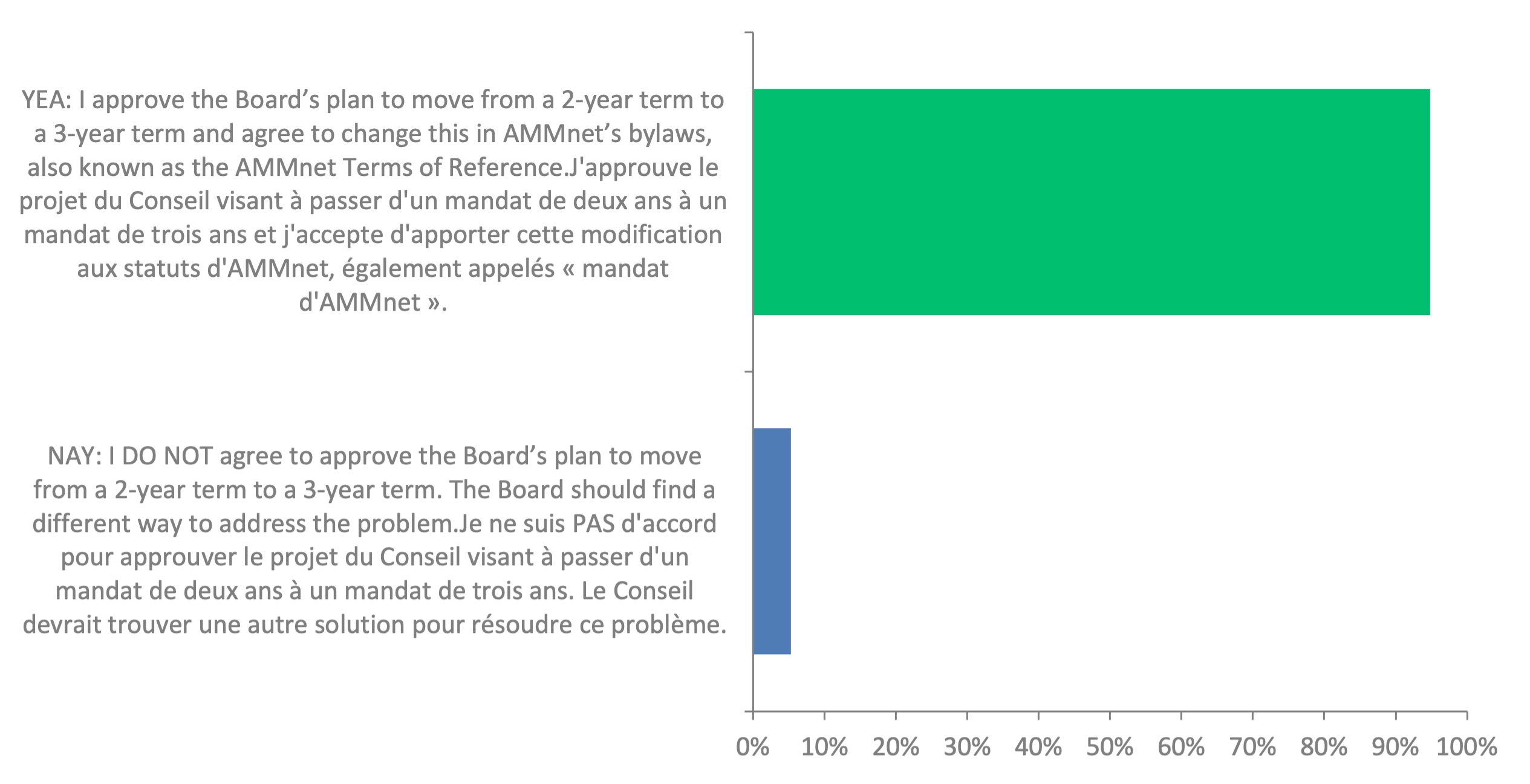
Out of 115 members who voted, 109 voted yes to move forward with the proposed changes, giving the Governance Committee and Board the confidence needed to proceed. Six members voted no, reflecting some hesitation about the change — and that's a perspective we take seriously.
We hope that, with this announcement and over the course of the next few years, we can continue to build your confidence in this decision. Extending the Board Terms and Chair Terms was not a decision we made lightly. We carefully weighed the pros and cons, and we believe this change will give AMMnet the stability it needs to keep growing and strengthening our community for years to come.
AMMnet has been built by volunteers like you, and we are continually grateful for the time, expertise, and energy you share with this community. Thank you!
What's Next: Board Transitions Ahead
In the coming months, we'll be celebrating and thanking some of our founding Board members and earliest elected Board members for their service, as they make way for new voices to join.
- This fall (2026), we will begin seeking new Board members to fill the seats being vacated by Caitlin Bever and Emilie Pothin. We're deeply grateful for their contributions and leadership.
- Additional Board members will complete their terms in May 2027, opening further seats for new members.
At each of these transition points, the AMMnet Governance Committee will be seeking eligible and enthusiastic volunteers to step into these roles.
Interested in Serving on the Board?
If you'd like to learn more about the eligibility requirements and expectations of AMMnet Board members, you can find full details in the Terms of Reference on the AMMnet website at the link below.
Thank you again to everyone who voted, and to everyone who continues to give their time and talent to make AMMnet a thriving, member-driven community.
Board Meeting Summary
August 18
Board Members Present: Hannah, Caitlin, Emilie, Justin, Mor, Cherlynn, Antonio (voted in absentia: Luc and Susan)
Secretariat Present: Shannon and Selen
DISCUSSION
General Assembly Follow-Up and Board Member Terms
- 115 AMMnet members participated in the General Assembly vote, with an overwhelming majority voting “Yea” to approve the proposed revisions to Board member terms.
- Secretariat to share:
- Detailed voting results through an announcement email/newsletter.
- Board members scheduled for term extensions.
- Board members whose terms are ending.
- The plan and timeline for upcoming Board elections.
Annual Reporting to AMMnet Membership
- Following feedback received during the General Assembly, the Board discussed the possibility of providing an annual report/update to AMMnet members.
- Secretariat to evaluate and consider using content from the Annual Leadership Meeting slides as the basis for annual reporting to membership (as this is comprehensive and provides an accurate picture of the "state of AMMnet" and plans for the coming year.
- Secretariat to consolidate a year of Board minutes into a report and evaluate whether this could also serve as a report for membership.
Terms of Reference Revisions: Incorporated Board and Membership approved Board and Board Chair revised Terms.
- Secretariat drafted, revised with Board comments, and finalized draft for vote.
- The Board voted to adopt the revised ToR as presented:
- Yeas: 9
- Nays: 0
- Abstentions: 2
Board Elections and Nominations
- The Board discussed potential candidates to fill 2–3 upcoming Board vacancies.
- 14 potential candidates from were identified and discussed.
- The Board also discussed strengthening NMCP/PNLP representation, with the expectation that these representatives should be voting Board members.
- 6 Potential NMCP/PNLP candidates were identified and discussed.
- Additional candidate suggestions remain welcome.
- Hannah, Jaline and Shannon to discuss responsibility for reaching out to prospective Board candidates during the next BC-ED meeting.
The next Board meeting: October 20, 16 hr UTC.